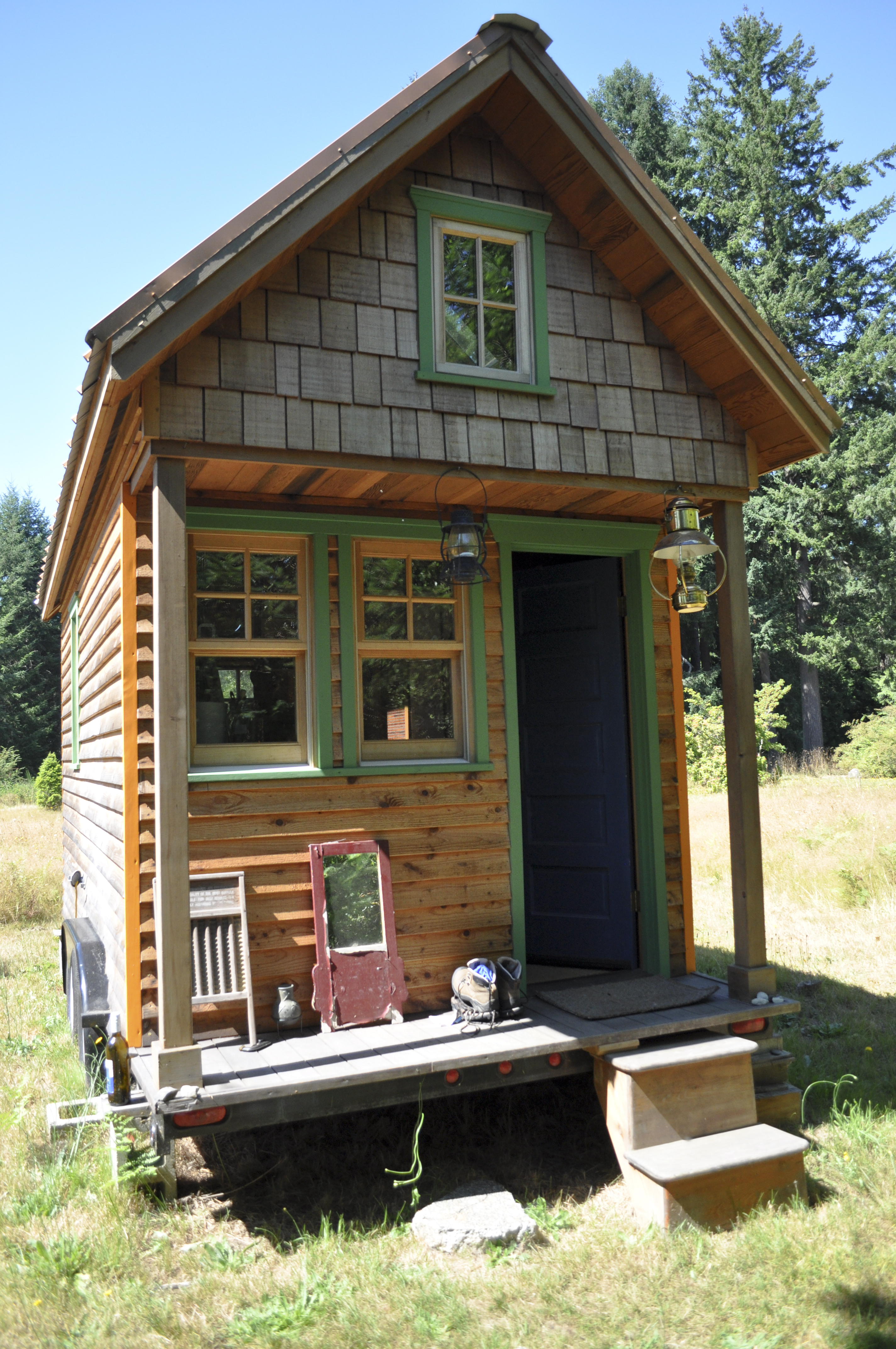
Canada has no national zoning framework for tiny houses. Land use regulation is a provincial jurisdiction, and municipalities derive their zoning authority from provincial legislation — the Municipal Government Act in Alberta, the Local Government Act in British Columbia, the Planning Act in Ontario, and equivalent statutes elsewhere. This means the rules vary considerably depending on where a tiny house is being placed, and what applies in one municipality may not apply twenty kilometres away in a different jurisdiction.
The two regulatory tracks
Whether a tiny house is classified as a dwelling (subject to residential zoning and building codes) or as a vehicle (subject to motor vehicle regulations) depends primarily on whether it has a permanent foundation. This distinction creates two entirely separate regulatory tracks.
Tiny houses on wheels (THOW)
A THOW is built on a road-legal trailer and remains movable. In most Canadian provinces, a THOW is classified as a recreational vehicle. This classification has practical consequences:
- It generally does not require a building permit for construction (it falls outside building code jurisdiction).
- Year-round occupation of an RV is prohibited in most residentially and agriculturally zoned areas unless the owner has an approved seasonal use or rural residential designation.
- Some municipalities have created specific THOW or tiny home bylaws that carve out defined conditions for legal occupation — usually in rural zones, campground-designated areas, or on lots where a primary dwelling already exists.
- The THOW itself must meet provincial motor vehicle standards for road transport (axle load limits, lighting, width and height maximums).
British Columbia has been among the more active provinces in developing regulatory pathways for THOWs. Several regional districts (notably the Cariboo Regional District and the Regional District of Central Kootenay) have updated their zoning bylaws to allow THOWs as secondary dwelling units on rural lots under specific conditions.
Tiny houses on permanent foundations
A tiny house placed on a concrete slab, piers, or other permanent foundation is classified as a residential dwelling in all Canadian provinces. This brings it fully under residential zoning and building code jurisdiction. Key zoning parameters that affect these dwellings include:
- Minimum dwelling size: Some municipalities specify a minimum gross floor area for dwelling units — figures in older bylaws range from 50 m² to 70 m². Newer bylaws in many jurisdictions have reduced or eliminated these minimums to encourage housing density and small-scale infill.
- Minimum lot size: Single residential zones commonly require 250–500 m² minimum lot areas in urban settings.
- Setbacks: Front, rear, and side yard setbacks constrain the building envelope. On small urban lots, setback requirements may leave insufficient area for a tiny house footprint.
- Lot coverage maximums: The proportion of a lot that can be covered by all structures (primary dwelling, garage, accessory buildings) is limited — typically 40–55% in residential zones.
Accessory dwelling units (ADUs)
The most common zoning pathway for a tiny house on a permanent foundation in an urban or suburban setting is as an accessory dwelling unit (ADU) — sometimes called a secondary suite, garden suite, or carriage house, depending on the province and municipality.
An ADU is a self-contained dwelling unit on a lot that also contains a primary dwelling. As a secondary unit, it must comply with the same building code requirements as any other residential occupancy, but the zoning rules for ADUs are distinct from those for primary dwellings in most municipalities.
British Columbia ADU policy: In 2023, the BC government passed legislation (Bill 44 and related housing statutes) requiring municipalities to permit secondary suites and accessory dwelling units as-of-right in most single-family residential zones province-wide. This significantly reduced barriers to placing garden suites and detached ADUs on existing residential lots.
Provincial regulatory landscape
| Province | Relevant legislation | Notable recent changes |
|---|---|---|
| British Columbia | Local Government Act; BC Building Code | 2023 legislation mandates ADU permissions province-wide; regional districts vary on THOW bylaws |
| Alberta | Municipal Government Act; Alberta Building Code | Municipalities have broad discretion; Calgary and Edmonton have updated ADU bylaws; no provincial THOW standard |
| Ontario | Planning Act; Ontario Building Code | 2021 More Homes, More Choice Act (Bill 108) and subsequent legislation expanded as-of-right ADU permissions in municipalities |
| Manitoba | The Planning Act (Manitoba) | Municipal jurisdiction; Winnipeg updated ADU bylaws post-2020 |
| Saskatchewan | The Planning and Development Act, 2007 | Municipal discretion; rural municipalities vary considerably on small dwelling classifications |
| Nova Scotia | Municipal Government Act (NS) | HRM has explicit ADU and secondary suite frameworks; rural areas operate under county bylaws |
Rural land: agricultural and resource zones
Rural land in Canada is classified in categories that often restrict residential development. Agricultural Land Reserve (ALR) land in British Columbia protects farmland from non-agricultural development; residential use on ALR land requires approval from the Agricultural Land Commission (ALC) and is not guaranteed. Similar protections exist under Ontario's Greenbelt Plan and the Niagara Escarpment Plan.
Resource zones (forestry, mining) in most provinces allow resource extraction activities but not permanent residential dwellings unless a rezoning or variance is obtained. A rezoning application to a rural residential designation involves a formal public hearing process at the regional district or municipal level and can take six months to two years.
Crown land considerations
Vacant Crown land in Canada is provincially administered and is not available for private purchase in most cases. Provincial Crown land disposition programs exist in BC, Alberta, and other provinces for specific purposes (agricultural homesteading, backcountry cabins), but permanent residential dwellings require a land tenure arrangement — either a disposition or lease — from the provincial Crown land authority, subject to the province's land use objectives.
Variance and rezoning applications
When a proposed tiny house cannot meet current zoning requirements — because the lot is too small, the zone does not permit residential use, or the dwelling dimensions do not meet minimums — two formal approval routes are available.
A minor variance (development variance permit in BC) allows the local authority to grant relief from specific bylaw requirements where the relaxation is minor in nature and does not conflict with the intent of the bylaw. Minor variances are typically processed by a local authority committee and decided within two to four months.
A rezoning changes the land use designation of a parcel, requiring bylaw amendment, public notification, a public hearing, and council approval. Rezonings are more time-consuming (six months to over a year) and less certain in outcome than variance applications.